Affiliate Disclosure: To keep this project independent and free of monthly monitoring subscriptions, every item in this resource has been curated based on what actually works in the field. As an Amazon Associate, I earn from qualifying purchases. This helps support the maintenance of these guides.
The Complete Honeywell Vista 20P Parts Vault: Every Component That Belongs in a Contractor-Grade Install
If you’re sourcing Honeywell Vista 20P parts for the first time, or rebuilding a system that was never installed correctly to begin with, this is the only list you need. After 31 years in the trades, I’ve learned one rule that never changes: a system is only as reliable as its weakest component.
A no-name transformer, a knock-off sensor, or the wrong gauge wire on a keypad bus run will cost you more in diagnostic time than the three dollars you saved at checkout.
All Honeywell Vista 20P Parts documented in this vault represents the hardware standard used in a real, production-scale residential installation — the same components specified in THE VISTA-20P WORKHORSE: The Field Guide to Modernizing Your Honeywell Security System. This is not a generic affiliate list. This is a contractor’s bill of materials.
I. The Silicon Infrastructure: Apple Home Hub Foundation
Before a single zone is programmed, the local network infrastructure has to be solid. The Vista 20P’s integration with Apple Home runs through a chain of local hardware — not cloud servers — and every link in that chain needs to be wired, stable, and always-on.
This is the “Digital Bridge” layer that allows your panel to communicate with your smart home ecosystem without routing data through an outside server. To achieve this level of ironclad local responsiveness, you must audit your physical layout to ensure you are sourcing legitimate, high-grade Honeywell Vista 20P Parts that can handle continuous communication without dropping terminal voltages or desynchronizing from your network bus.
- The Wired Foundation: Apple TV 4K — A wired Ethernet connection provides the most stable “always-on” connection for security monitoring. This is your HomeKit hub. Run a dedicated Cat6 drop to its location. Never rely on Wi-Fi for a security-critical hub device.
II. The Surveillance Vault: Network and NVR Infrastructure
Camera footage without a local NVR is just data you don’t own. The surveillance stack below is built around local storage, Power over Ethernet delivery, and cameras that integrate natively with Scrypted for Apple Home live video — no subscription, no cloud dependency, no footage held hostage by a third-party service.
While cameras handle your physical visual perimeter, bridging this high-definition surveillance matrix with physical entry sensors requires matching your network infrastructure with the rugged, reliable Honeywell Vista 20P Parts running inside your primary automation enclosure to achieve comprehensive, zero-latency situational awareness.
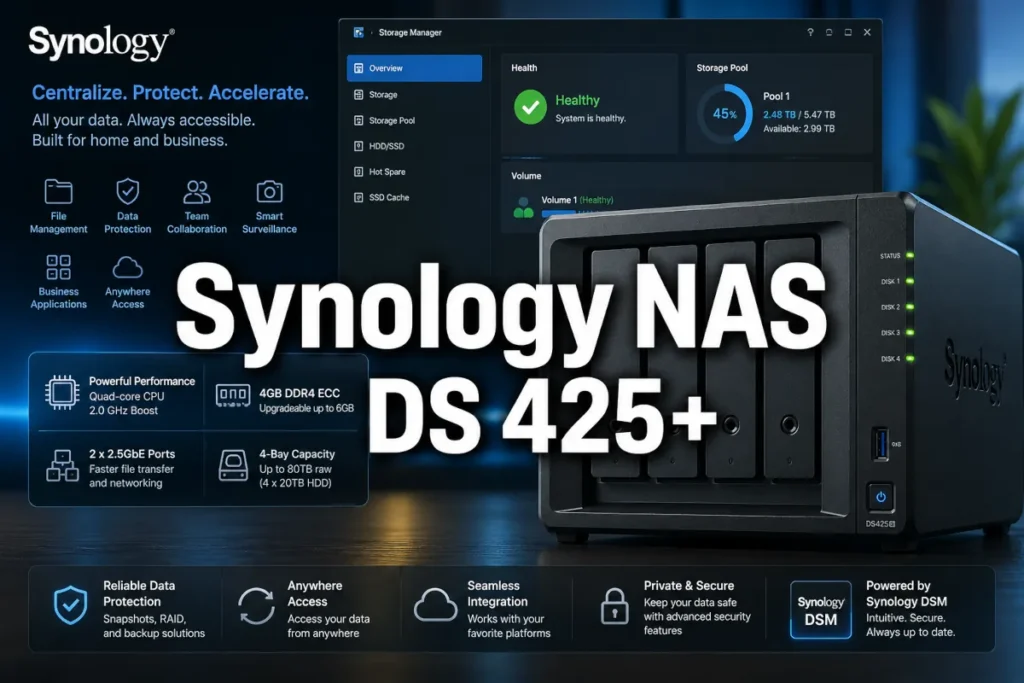
- The Network NVR: Synology DS425+ 4-Bay NAS — The “Black Box” for Surveillance Station and Homebridge. This unit runs both your NVR software and your Homebridge instance on a single low-power platform, keeping your entire local integration stack consolidated in one enclosure.
- 4TB Hard Drive: WD Purple 4TB Surveillance Hard Drive — Engineered specifically for 24/7 recording. Features AllFrame technology to reduce frame loss and improve video playback. Do not substitute a desktop or NAS drive here — surveillance workloads require a drive rated for continuous write cycles.
- 8TB Hard Drive: WD Purple Pro 8TB Surveillance Hard Drive — High-capacity storage for AI-enabled recorders and deep learning solutions. Built to handle heavy workloads of up to 550TB/year. Spec this unit if you are running motion analytics or object detection at the NVR level.
- 5 Port PoE+ Switch: TP-Link 5-Port Gigabit PoE+ Switch — Provides both data and power to your IP cameras over a single cable. Supports a 65W total power budget. One cable per camera run is the correct field standard — never power an IP camera from a wall outlet when PoE is available.
- PoE+ Injector: TP-Link Gigabit PoE+ Injector — Perfect for adding a single high-power camera to your network without upgrading your entire switch. Simple plug-and-play setup with no configuration required.
- Cat6 Outdoor Ethernet Cable: trueCABLE Cat6 Direct Burial Bulk Ethernet (500ft) — The “Silicon” highway for your exterior camera runs. UV-resistant and waterproof for extreme outdoor environments. Direct burial rated means no conduit required for underground runs, though conduit is always the preferred field practice for long-term durability and future serviceability.
- Bullet Camera: Amcrest 5MP Outdoor PoE Bullet Camera — A rugged, high-resolution workhorse. The 2592 x 1944p resolution provides enough detail to identify faces at a distance, and its bullet form factor acts as a visible deterrent on any exterior elevation.
- Turret Dome Camera: Real HD 6MP ColorVu Turret Dome Camera — The heavy-hitter for night security. Unlike standard cameras that switch to grainy black-and-white at dusk, ColorVu technology uses a large aperture to deliver Full Color Night Vision in near-total darkness. Critical for identifying vehicles and individuals at night without the washed-out infrared look.
III. The Core Honeywell Vista 20P Parts: The Brain and Power Stack
This is the physical “Iron” of the system — the hardwired components that form the non-negotiable foundation of every Vista 20P installation. Cut corners here and you are building on sand.
Every component below has been field-verified in a production residential install. Material performance at this layer determines the reliability of every zone, every output, and every integration built on top of it.
To guarantee this unshakeable technical foundation, you must inventory your setup against a vetted manifest of commercial-grade Honeywell Vista 20P Parts that are structurally engineered to handle constant terminal signaling without causing resistance drift or false panel faults.
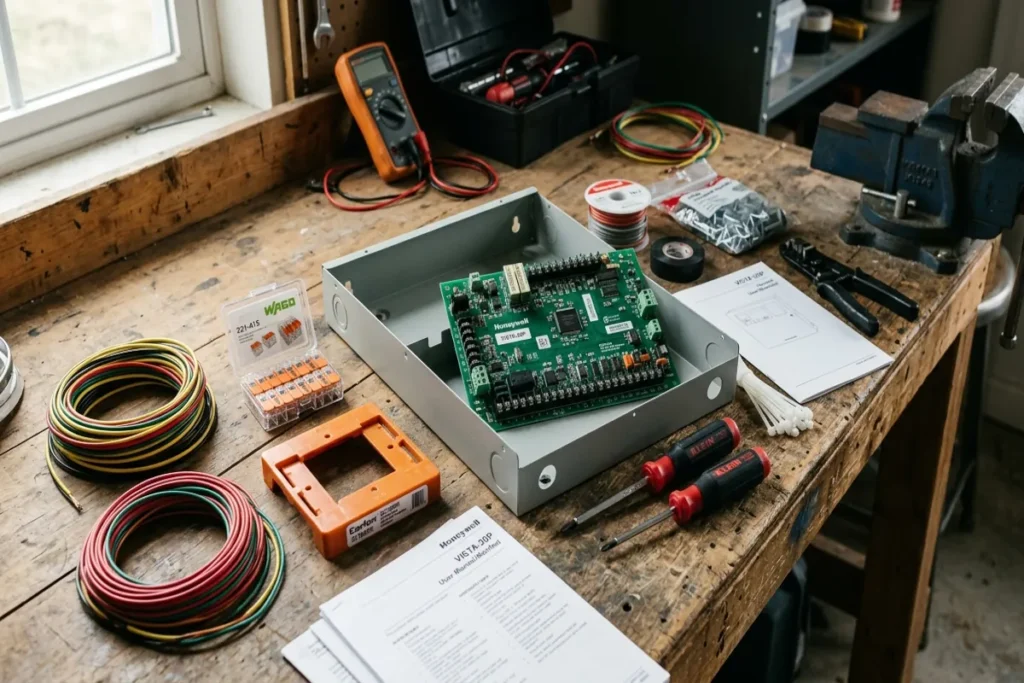
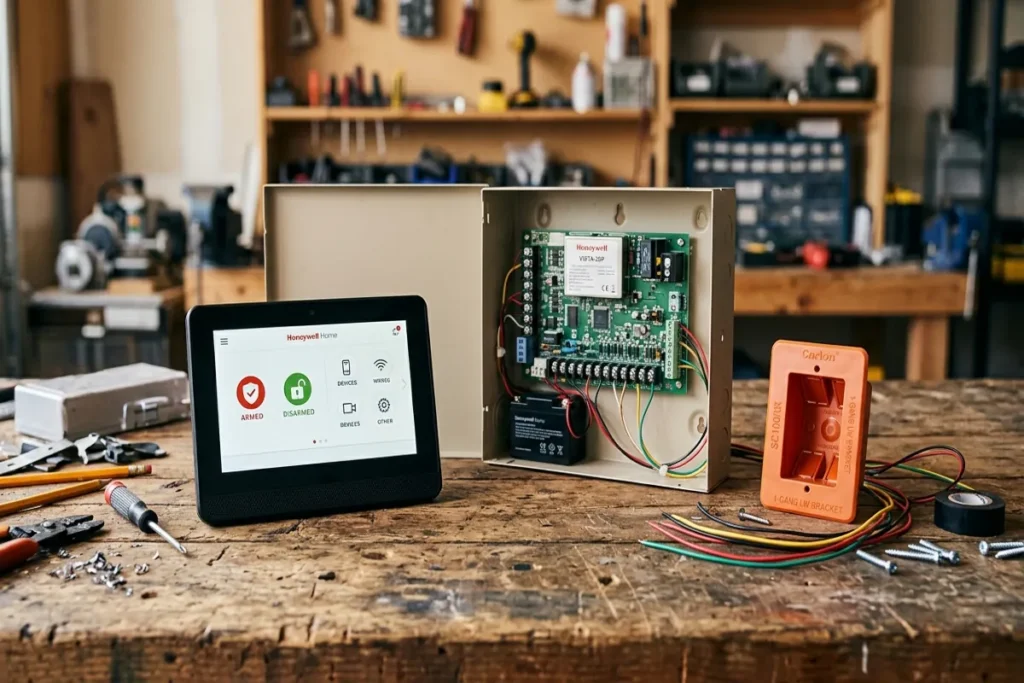
- The Main Brain: Honeywell VISTA-20P 3 Piece Control Panel Kit — Includes the board, 6160V keypad, and cabinet. This is the legendary foundation of residential hardwired security. Up to 48 zones, dual-partition support, ECP bus architecture, and a programming structure that has been field-proven for decades. This is the anchor of the entire system.
- The Local Bridge: Envisalink EVL-4EZR — The essential piece for Apple Home integration and local network control. Connects to the Vista 20P’s ECP bus and hosts a local API that Homebridge reads in real time. Your panel data stays on your network — zero cloud dependency, zero subscription.
- The Vault Power: Altronix SMP3 Auxiliary Power Supply — Clean, regulated 12VDC power for sensors, bridges, and auxiliary devices that exceed the Vista 20P’s onboard 600mA auxiliary output. When your current draw exceeds the panel’s onboard limit, the SMP3 is the correct field solution — not a daisy-chained wall adapter.
- The Transformer: 16.5V 40VA 2.4A Transformer — Spec two of these: one dedicated to the VISTA-20P panel and one for the SMP3. A shared transformer is an undersized transformer. Dedicated circuits for dedicated loads is the correct trade practice, full stop.
IV. The Interface Layer: Keypads and Touchscreens
The keypad is your daily touchpoint with the Vista 20P. It is also the primary diagnostic tool during programming and zone testing. Selecting the right keypad for the right location is not a cosmetic decision — it is a functional one.
The 6160RF, for example, eliminates the need for a separate RF receiver module, which simplifies the wiring topology and reduces the total Honeywell Vista 20P parts count in a wireless-heavy installation.
Ensuring you choose the exact physical keypad interface to match your blueprint is a critical step, as selecting high-grade Honeywell Vista 20P Parts at this primary control layer directly impacts your ability to cleanly troubleshoot zone expansions and enter configuration commands without latency.
- The Workhorse: Honeywell 6160RF Custom Alpha Keypad — A must-have for programming and managing wireless sensors. The integrated RF receiver handles 5800-series sensor enrollment directly at the keypad, no additional module required. This is the field-preferred keypad for any installation that includes wireless sensors.
- The Voice: Honeywell 6160V Voice Keypad — (*Currently the best value on the 6160V is included in the 3 Piece Control Panel Kit above.) Provides audible status updates and the classic entry/exit tone. Ideal for secondary keypad locations where voice annunciation adds operational clarity.
- The Visual Dashboard: Honeywell Tuxedo Touch 7″ Color Touchscreen — Built-in Z-Wave Plus hub and IP Camera viewer. Wires to the ECP bus on the same 22/4 data cable run as a standard keypad. Provides a full graphical interface for zone status, arming, and camera thumbnails at a glance.
- The Thermostat: Honeywell T6 Pro Z-Wave — Local-first temperature control without the cloud ransom. Pairs to the Tuxedo Touch’s integrated Z-Wave hub for unified control from the panel interface.
V. The Wireless Sensor Fleet: Perimeter and Interior Protection
The 5800-series wireless sensors are the field standard for Vista 20P residential installations. They communicate on the 345MHz frequency, enroll directly through the 6160RF keypad, and require no wiring beyond battery installation.
Hands-on experience with these sensors over hundreds of installs confirms one consistent finding: proper placement geometry and correct zone type assignment matter more than sensor quantity.
One well-placed PIR motion detector covering a choke point outperforms three sensors positioned without a layout plan. Sourcing authentic Honeywell Vista 20P Parts for your wireless deployment guarantees that the internal transmitter signals remain strong, stable, and completely secure across every protective zone.
- Door/Window Protection: Honeywell 5800MINI (2-Pack) — Discreet and reliable wireless perimeter protection. The low-profile form factor installs flush on door and window frames without visible gap-bridging hardware. Powered by a CR2032 coin cell.
- Glass Break Detection: Honeywell 5853 Wireless Detector — Listens for the specific acoustic frequency of shattering glass. One unit covers up to 25 feet in all directions — a single sensor can protect an entire room of windows when mounted correctly at the ceiling centerline.
- The Spatial Sentry: Honeywell Home 5800PIR-RES Motion Detector — Pet-immune up to 80 lbs with expansive 35′ x 45′ coverage. Mount at 7.5 feet, aimed diagonally across the protected space. This is the correct placement geometry for maximum detection coverage with minimum false-alarm risk.
- Garage Security: Honeywell 5822T Garage Tilt Sensor — The simplest, most reliable method for monitoring a standard overhead garage door. Mounts directly to the door panel — no wiring, no magnets, no alignment tolerance issues.
- Garage Control: ratgdo v3 — The subscription-killer for your garage door. Integrates directly with the garage door opener’s security+ 2.0 protocol and bridges to Apple Home via Homebridge. Local control, no cloud, no monthly fee.
VI. Life Safety and Sound: The Protection You Can’t Ignore
A security system that only monitors intrusion is an incomplete system. The Vista 20P supports dedicated 24-hour life safety zones — Zone Type 08 — that remain active regardless of armed status.
Gas detection, smoke integration, and CO monitoring belong on their own hardwired or wireless zones, supervised independently from the perimeter and interior zones. These are not optional add-ons.
They are the difference between a security system and a life safety system. Integrating verified Honeywell Vista 20P Parts at this critical layer ensures that life safety relays, supervised loops, and backup batteries operate with total electrical stability when milliseconds count.
- Gas Safety: Macurco GD-2B Natural Gas Detector — Industrial-grade natural gas detection for the kitchen or mechanical room. Wires to an auxiliary zone input on the panel for supervised monitoring. This is the correct specification for a hardwired gas detection zone — not a standalone plug-in consumer unit.
- The Listener: Encore Firefighter FF345 — Wirelessly integrates existing smoke detectors into your VISTA panel by listening for the standard T3 smoke alarm pattern. This is the field-correct solution for adding smoke monitoring to a Vista 20P without rewiring existing detector circuits.
- 2-in-1 Safety Sentry: X-Sense SC07-W Smoke and CO Detector — 10-year sealed battery with a clear LCD display. Pairs with the Encore Firefighter for wireless panel integration. The sealed battery eliminates the single most common life safety failure mode: a removed or dead battery.
- The Siren: Honeywell WAVE2 Two-Tone Siren — High-decibel outdoor sounder wired to the Vista 20P’s bell output terminals using 18/2 stranded wire. The two-tone pattern is acoustically distinct from vehicle alarms and neighborhood noise, reducing the risk of alarm fatigue in dense residential areas.
VII. Contractor Supplies: The Finishing Items That Separate a Pro Install from a Hack Job
The difference between a system that holds up for 20 years and one that generates service calls in year two is almost always found in the finishing details — the wire connectors, the mounting hardware, the labeling discipline.
These are the supplies that never show up in a consumer parts list but are non-negotiable on a contractor-grade installation. Structural integrity at the connection level is what makes a hardwired system hardwired.
When completing your panel enclosure wiring, utilizing professional-grade Honeywell Vista 20P Parts for your terminations, terminal expansions, and sub-panel bussing ensures that resistance values remain completely locked in for decades to come.
- The “Beans”: Low Voltage B-Connectors (100 pcs) — The gold standard for low-voltage wire splicing in junction boxes and sensor housings. Pre-filled with gel that seals the connection against moisture. The correct tool for any splice that lives in a wall cavity or exterior enclosure.
- The Modern Splice: Wago 221-415 Lever-Nuts — Faster, cleaner, and more reliable than traditional wire nuts for panel-side connections. The lever mechanism allows a solid, vibration-resistant connection without over-twisting fine stranded wire. These are the correct connector for ECP bus splices inside the panel enclosure.
- The Foundation: Carlon SC100RR Low-Voltage Bracket — Ensures your keypad and sensor mounts are level and plumb. Installs between studs without a junction box, providing a solid, code-compliant mounting surface for keypads, motion detectors, and glassbreak sensors.
- Power Wire: SYSTON 18/2 (Power) Wire — Stranded cable for siren runs and transformer drops. The correct gauge for the Vista 20P’s bell output circuit. Never substitute solid-core wire on a siren run — stranded handles the vibration and thermal cycling of an outdoor bell enclosure without conductor fatigue.
- Data Wire: Elite 22-4 (Data) Wire — Stranded cable for keypad bus runs and Tuxedo Touchscreen wiring. Four conductors cover your 12V power pair and your ECP data pair in a single jacket, keeping the panel enclosure clean and the bus run manageable.
- Wire Markers: Ideal Wire Markers — Electrical 44-103 Wire Marker Booklet. Every wire that enters the panel enclosure gets labeled at both ends before the terminal screw is tightened. This is non-negotiable. A panel with unlabeled wires is a diagnostic nightmare for every technician who touches it after you.
VIII. The Energy Reserve: Sensor Batteries and Panel Backup Power
A security system that goes dark during a power outage is a security system that failed at the worst possible moment. The Vista 20P’s onboard battery charger maintains the backup battery at float voltage during normal operation, providing seamless transition to battery power the instant AC is lost.
Selecting the correct battery chemistry and capacity for your specific load is part of the diagnostic approach to any Vista 20P installation — not an afterthought. Incorporating high-quality Honeywell Vista 20P Parts into your power distribution layout ensures the auxiliary power supply and backup cells switch over with zero drop in line voltage, protecting your automation nodes from an unexpected system reboot.
- The Coin Cell: CR2032 3V Lithium Battery — Powers the slimmest components in your fleet, including the 5800MINI door/window sensors and 5834-4 keyfobs. Expect 3–5 years of life from these compact sentries under normal supervisory polling cycles.
- The Powerhouse: CR123A 3V Lithium Battery — The high-drain battery that runs the 5800PIR-RES motion detectors and 5816 door/window contacts. Superior cold-weather performance makes this the correct specification for sensors in unconditioned spaces like garages and attics. Can last up to 10 years in PIR sensors under normal operating conditions.
- The 24-Hour Sentry: 12V 4Ah Sealed Lead Acid Battery — The standard backup for the VISTA-20P panel. Provides a minimum of 24 hours of standby power during a blackout at normal supervisory current draw. Replace on a 3-to-5-year preventative maintenance schedule regardless of apparent condition — sealed lead-acid chemistry degrades on a predictable curve.
- The High-Capacity Vault: 12V 7Ah Sealed Lead Acid Battery — The iron-grade upgrade for systems with high current draw from multiple keypads, sirens, or auxiliary devices. Fits the standard Honeywell panel cabinet and extends runtime significantly beyond the 4Ah baseline. This is the correct specification for any Vista 20P installation running more than one keypad and an outdoor siren simultaneously.
Every component in this vault has been evaluated against the same standard applied across 31 years of production-scale contracting work: does it perform reliably, does it hold up over time, and does it serve the system rather than complicate it? The field-tested methods behind every specification listed here are documented in full in THE VISTA-20P WORKHORSE: The Field Guide to Modernizing Your Honeywell Security System. This parts list is your bill of materials. The book is your build manual. Use both, and build a system that lasts.
Contractor’s Note: “I’ve listed these specific resources because they represent the standard of equipment I trust in my own home. Build it right, test it weekly, and keep your site safe.”
Gathering a complete inventory of commercial-grade components and sorting through compatible resistors is only half the battle when modernizing a legacy hardwired panel. Throughout my 31 years of active production-scale contracting work, I have consistently found that elite physical craftsmanship must be paired with precise, logical configuration to achieve true operational reliability.
Now that you have identified the exact expansion modules, power backups, and interface cards required for your specific physical layout, the next step is executing the core system configurations to map your zones correctly.
To transition from mounting boards to flashing firmware and defining alpha descriptors without triggering false system faults, follow our step-by-step Honeywell Vista-20p programming guides to program your system with complete confidence and establish an unshakeable home automation foundation.
Verifying Honeywell Vista 20p Parts | Equipment Standards and Hardware Compliance
When sourcing expansion boards, hardwired zone expanders, and upgraded power supplies to overhaul a legacy panel, maintaining absolute structural integrity depends entirely on utilizing equipment engineered to strict production-scale metrics.
Throughout my 31 years of active contracting and field experience, I have seen countles DIY installations fail prematurely because a builder used cheap, unvetted, off-the-shelf relays that could not handle steady low-voltage currents.
To guarantee that your physical layout, terminal footprints, and hardware modules are built to legitimate commercial-grade parameters, it is best practice to verify your component selections against the official architectural blueprints.
You can cross-reference your component layout directly with the manufacturing specifications on the public Resideo Engineering Registry to ensure your modernization blueprint is fully compliant with modern residential safety guidelines before mounting your hardware.
Contact and Technical Questions
If you have technical questions regarding the schematics, component specifications, or hardware covered in these guides, reach out directly:
- Email: david@cdavidchase.com
- Technical Line: 865-226-9721
To maintain the independence of this project and keep these guides free of corporate sponsorship, cdavidchase.com participates in the Amazon Services LLC Associates Program.
As an Amazon Associate, I earn from qualifying purchases at no extra cost to you.